
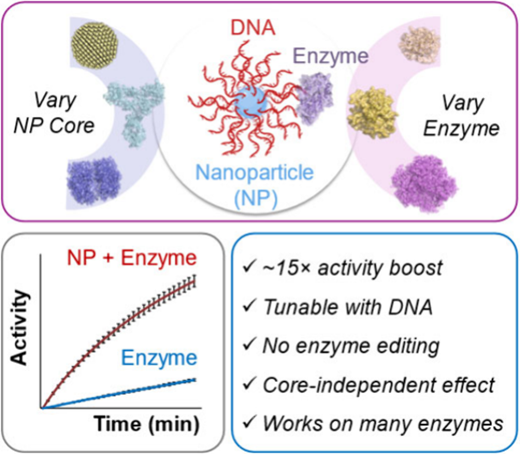
Dr. Devleena Samanta, an Assistant Professor in Chemistry, along with her students Seungheon Lee and Atri Bhattacharya, postdoctoral researcher Subrata Pandit, and a team of researchers have discovered that spherical nucleic acids (SNAs), nanoparticles surrounded by a dense layer of DNA, can interact with enzymes and enhance their activity without permanent chemical attachments or specially designed binding sites.
While improving enzyme function is normally complicated or time-consuming, the research team found an alternative way to significantly increase enzyme productivity without changing its structure or genetic sequence. Using the enzyme cytochrome c as the model, the team found that binding it to SNAs saw as much as a 15-fold increase in catalytic activity. Experiments showed that the improvement depended on the DNA molecules being densely arranged around the nanoparticle surface and that the effect also occured with other cores, including proteins and antibodies. This suggests that the effect is a general property of the SNA structure rather than a specific nanoparticle materials.
Most importantly, changing the DNA sequence around the nanoparticle altered the strength of the effect, providing a possible way to program or fine-tune enzyme performance by designing the sequences of the surrounding DNA. This approach could ultimately provide new ways to design more efficient enzyme-based systems for medicine and biotechnology.
Read more from their article, "Enhancing Enzyme Activity Via Noncovalent Association with DNA-Functionalized Nanoparticles," at the Journal of the American Chemical Society Au.
