
Back to Materials Analysis and Spectroscopy Facility
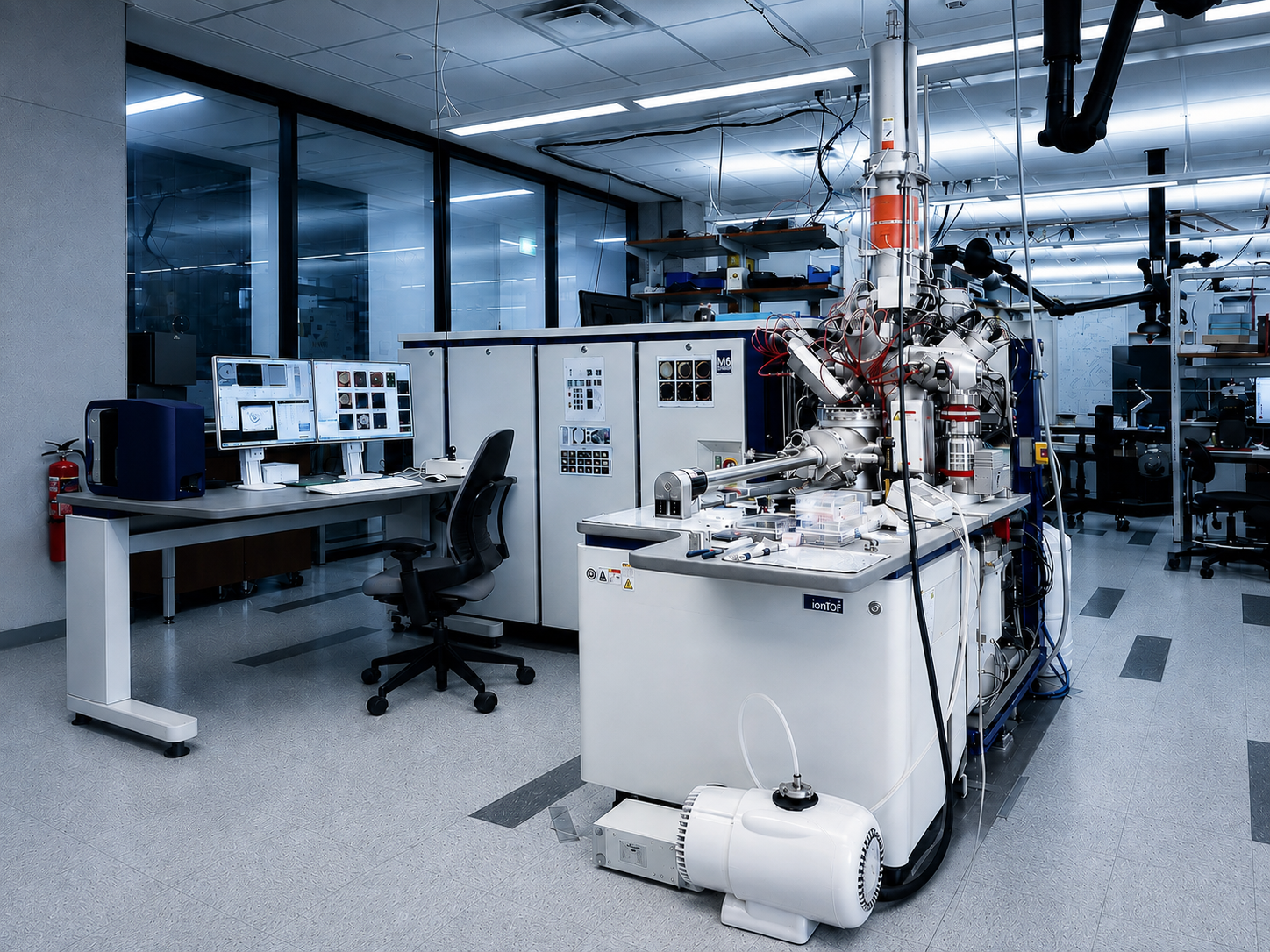
Time of Flight Secondary Ion Mass Spectrometer (TOF.SIMS M6)
Contact: Dr. Andrei Dolocan
Email: adolocan@austin.utexas.edu
Location: EER 6.636
Equipment Type:
Microscopy/Surface Analysis
Surface Analysis
Instrument Capabilities
The M6 is an ultra-high-resolution mass spectrometer capable of mass resolution down to 0.001 a.m.u. It provides comprehensive chemical composition analysis of both surfaces and bulk materials, with a mass range extending up to 14,000 a.m.u. The instrument offers elemental sensitivity at concentrations as low as parts-per-billion (ppb), while its surface-sensitive capabilities enable analysis of the outermost few atomic layers of a material.
Key features:
- Surface Spectroscopy:
- elemental and molecular ppb sensitivity
- < 1 nm surface sensitivity
- >30,000 mass resolution (m/δm)
- mass range up 14000 a.m.u.
- Surface Imaging:
- lateral resolution < 50 nm
- parallel mass detection
- Depth Profiling:
- depth resolution < 1 nm
- thin films from < 1 nm to few hundreds μm
- atomic mixing at buried interfaces
- 3D Analysis:
- high depth resolution
- high lateral resolution
- parallel mass detection
- Liquid Metal Ion Gun (LMIG)
- Binm+ source for analysis
- < few pA beam current – static SIMS limit
- 30 keV and 60 keV ion energy
- < 50 nm lateral resolution
- Dual Source Column (DSC)
- high current Cs+, O2+, and Ar+ sources for sputtering
- > 40 nA to > 1 µA beam current
- 250 eV to 2 keV ion energy
- Gas Cluster Ion Beam (GCIB)
- high current Arn+ source for depth profiling of large organic molecules
- Focused Ion Beam (FIB)
- high current Ga+ (30 keV) source for fast FIB
- imaging in cross section of very difficult samples
- Data Analysis:
- complete data recording (mass, position and intensity)
- data can be revisited anytime for additional analysis without further sample analysis
- Air-free Sample Transfer Capability:
- air-free capsule available for sample transfer to and from user glove boxes
- heating (up to 900 K) and cooling (down to 80 K) are available
Accepted Samples: metals, semiconductors, insulators, organic or inorganic, in solid or powder (needs to be pressed) form, fluid inclusions
Available Sputtering Species:
- Analysis Species: Bi1+ (30 kV), Bi3+ (30 kV), Bi3++ (60 kV), Arn+ cluster
- Sputtering Species: Cs+ or O2+ (250 V to 2 kV), Arn+ cluster and Ga+
Fees and Policies
- UT Users: $65/hour
- Higher Education/State Agencies: $248/hour
- Corporate/External Users: $248/hour
Training
Users should register for the required in-person training course through UTLearn.
